
Global Entry
U.S. Customs and Border ProtectionTravel & Local
4.9461.00 Reviews
- Version
- 2.2.0
- Installs
- 500.00K
- Age Rating
- Everyone
Screenshots
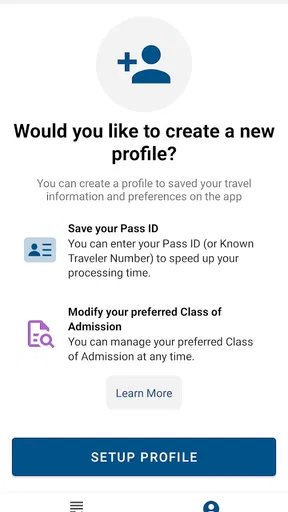
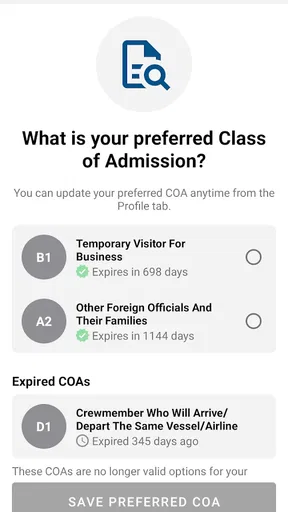
Our Review of Global Entry
 Analysis by Appyee
Global Entry is a focused travel companion rather than a complete airport guide, and that narrow purpose is exactly why I find it useful. After using it, my view is simple: if you already belong to the Global Entry program and regularly arrive in the United States through participating airports, this free app can make the arrival process feel more organized. If you are not a member, or if your trips rarely involve supported locations, it offers very little reason to stay installed.
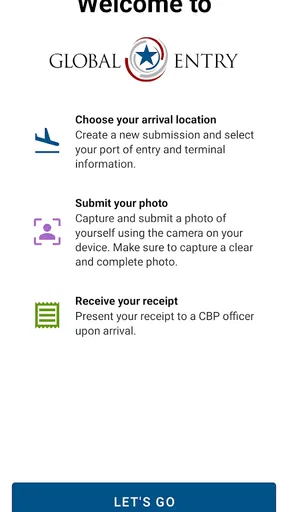
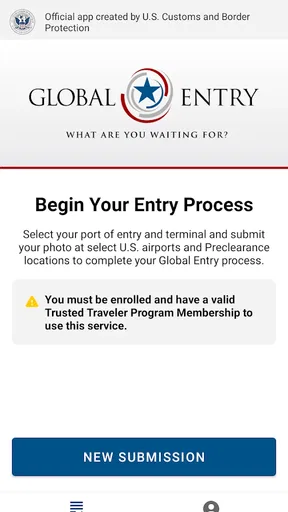
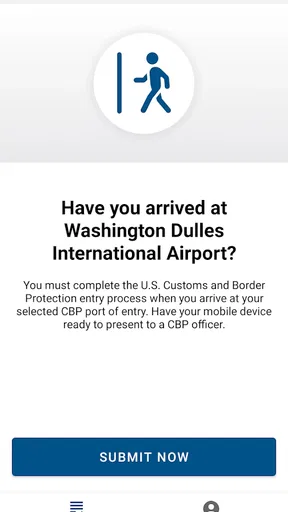
The app comes from U.S. Customs and Border Protection and sits in the Travel & Local category. Its job is to let Global Entry members report their arrival at supported airports. That may sound modest, but travel apps often become frustrating when they try to cover everything from flights and hotels to maps and airport shopping. This one is easier to understand because its usefulness is tied to a specific moment: arriving after an international trip and needing to complete the Global Entry process.
My main takeaway is that Global Entry works best as a specialized arrival tool, not as a general travel app. It does not replace an airline app, a passport, airport directions, or a broader customs resource. Instead, it adds a direct mobile step for eligible travelers who want to handle their arrival report through their phone.
What the app does well during an international arrival
I find this app’s biggest strength is how directly it serves a particular moment: an eligible member’s arrival at a supported airport. Before relying on it, I’d make sure my account is ready and check that the airport fits my trip, then keep following the airport’s instructions rather than assuming the app replaces them. That practical boundary helps explain where it earns a place—and where a broader travel tool is the better choice.
A clear purpose makes the experience easier to understand
The first strength is the app’s focus. When I open it, I am not trying to find a hotel reservation or compare flights. I am dealing with the Global Entry arrival process. That clear purpose matters when I am tired, carrying luggage, and moving through an unfamiliar terminal. A travel app with too many unrelated menus can create more work at precisely the wrong time.
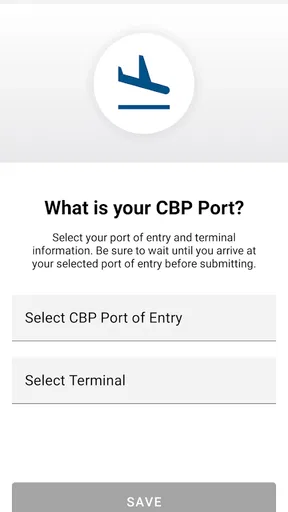
For a Global Entry member, the central value is the ability to report an arrival at a supported airport from the app. The workflow is built around eligibility and location, so the most important question is not whether the app has dozens of features. It is whether the airport and arrival situation fit the service. When they do, the app feels much more relevant than a generic airport utility.
I also appreciate that the application does not pretend to be a replacement for every part of the border process. Its role is specific, and that makes it easier to judge. A person looking for flight delay alerts should use the airline’s application. Someone planning a complete itinerary needs a trip-planning service. A Global Entry member checking in after an international flight has a much more precise reason to use this one.
It fits a realistic travel routine
Consider a common scenario. I return from a work trip, land at a supported airport, and have only a short window before a connecting domestic flight. My phone is already in my hand because I am checking the connection and messaging the person picking me up. Having the Global Entry arrival task in the same device means I can deal with that step without searching through paper notes or switching between unrelated airport information.
The practical advantage is not that the app makes the whole airport faster in every situation. It is that it gives the arrival report a dedicated place. That distinction is important. The app can simplify one part of the process, but I still need to pay attention to airport instructions and complete whatever other steps apply to my trip.
Another useful habit is to think about the app before landing rather than waiting until I am standing in a crowded area with weak attention and a low battery. I would check that I can sign in, keep the application available on my phone, and know whether my destination is supported. This preparation is more valuable than expecting the app alone to solve every arrival complication.
The public response suggests strong practical appeal
Global Entry has an average rating of 4.9 from around twelve thousand ratings, with more than four hundred written reviews. It has also passed half a million installs. Those figures do not guarantee that every traveler will have a smooth experience, but they do indicate that the app has found a clear audience among people who need this particular service.
I would interpret that response carefully. A specialized app can receive enthusiastic feedback because it solves an important problem for the right group, while still being almost irrelevant to everyone else. In this case, the strong reception makes sense: members are not downloading it to browse content; they are looking for a practical way to handle a government travel procedure.
Basic access makes it easy to try
The app is free, carries an Everyone age rating, and runs on Android devices using version 8.0 or later. Its current version is 2.2.0. Those details make the barrier to trying it fairly low for compatible Android users. I do not need to budget for another travel subscription simply to test whether the arrival workflow fits my trips.
The free price is especially sensible here because this is not an app I would use every day. Its value appears around international arrivals, which may be occasional even for frequent travelers. Charging a recurring fee would make the decision much harder, while free access lets eligible members keep it available for the occasions when it matters.
That said, compatibility is still worth checking before a trip. A traveler using an older Android phone may not be able to install the current release, and an app that cannot be opened at the airport is no help at all. I would verify the operating system and update the app before leaving, rather than treating installation as something to handle after landing.
Useful preparation is more important than constant use
One of the less obvious points about Global Entry is that its best use may happen before the airport experience becomes stressful. I would install it while connected to reliable Wi-Fi, open it at home, and make sure my account access is ready. This is a small step, but it avoids turning a simple arrival task into a password-recovery exercise beside baggage claim.
I would also keep the phone charged and avoid assuming that airport connectivity will be perfect. The app’s purpose depends on using a phone at a busy travel location, so practical phone preparation matters: a charged battery, current software, and enough time to read the on-screen instructions. None of these are glamorous features, but they are the difference between a useful travel tool and an app that is technically installed but practically unavailable.
Families and groups should think about the workflow separately for each traveler. One person carrying several passports should not automatically assume that one completed action covers everyone in the party. I would follow the app’s instructions for each eligible traveler and avoid rushing through the process simply because the group is waiting. That is a more careful approach than treating the app like a single group check-in button.
The biggest limitation is its dependence on eligibility and airport support
The meaningful weakness is also the app’s defining boundary: it is for Global Entry members reporting arrivals at supported airports. If I am not enrolled, the application does not become a shortcut into the program. If I arrive somewhere outside the supported network, the central function may not help me at that moment. This is not a minor limitation; it determines whether the app is useful at all.
That makes it very different from a general airport application. A typical airport app may provide terminal maps, gate information, parking guidance, restaurants, or flight updates. Global Entry does not compete with those tools on breadth. Its advantage is specialization, but specialization means I should not install it expecting a complete travel dashboard.
It is also not a substitute for checking the requirements of my particular trip. Travel conditions can vary by airport, arrival route, and personal circumstances. I would not assume that using the app eliminates the need to follow signs, respond to official instructions, or handle other border and baggage procedures. The safest approach is to treat it as one part of the arrival process, not as permission to ignore the rest.
There is a second kind of friction: the app’s usefulness is tied to a moment when travelers are often distracted. I may be dealing with children, luggage, a connecting flight, or a dead phone battery. A narrowly designed app cannot remove those real-world pressures. It can provide the intended mobile route, but I still need to use it attentively and leave enough time for the airport process around it.
How it compares with the usual alternatives
The closest alternative is often not another app but the standard airport process. A traveler can follow the normal instructions and use the facilities available on arrival. That may be perfectly adequate for someone who travels internationally only once in a while, is not a Global Entry member, or does not want another app on the phone.
For members, however, the dedicated application is more direct than trying to find the same task inside an airline app. Airline software is built around reservations, boarding passes, flight status, and loyalty accounts. It generally serves the journey before and after the border process, while Global Entry is designed for this particular government-arrival interaction. Using the correct tool can reduce the temptation to search through an airline’s unrelated menus.
Airport-specific apps remain better for terminal navigation and local services. If I need to locate a baggage carousel, find a lounge, or understand a transfer between terminals, I would choose the airport’s own application or website. If I need to report my arrival as an eligible Global Entry member at a supported airport, this app is the more appropriate choice.
That division of labor is important. I would not delete my airline app or airport map after installing Global Entry. Instead, I would keep each tool for its strongest job. The benefit comes from avoiding the wrong app for the task, not from expecting one application to manage the entire trip.
Who should install it, and who should skip it?
I recommend Global Entry to current members who arrive internationally through supported airports often enough to value a dedicated mobile workflow. It is also a sensible install for people who have an upcoming qualifying trip and want to prepare in advance. Frequent business travelers, families returning from overseas holidays, and anyone who dislikes searching for government travel steps on a crowded airport network are the most natural audience.
I would be more selective for occasional travelers. If I take one international trip every few years, I might install it shortly before that journey, test access at home, and remove it afterward if I do not expect to use it again soon. Because it is free, keeping it installed costs little in financial terms, but phone storage and notification clutter can still matter.
I would skip it if I am not a Global Entry member, if my normal travel is domestic, or if my destinations do not include supported airports. In those cases, an airline app, airport app, or ordinary travel-planning tool is likely to be more useful. Installing a specialized government travel app without a matching use case only adds another icon to manage.
It is also not the right choice for someone seeking a full explanation of immigration programs, a trip organizer, or a live airport companion. The app’s narrow focus is a benefit for eligible users and a drawback for everyone else. Knowing that before downloading is more helpful than judging it by the standards of a completely different travel product.
Small habits that make the app more dependable
I would take three practical steps before relying on it. First, install and open it while at home, where I can deal with account access calmly. Second, check the destination and arrival details before boarding, rather than waiting until I am moving through the terminal. Third, keep a backup plan by knowing where to follow official airport instructions if the phone, connection, or app does not cooperate.
I would also avoid treating a successful screen in the app as the end of the journey. After submitting an arrival report, I would continue following airport signs and any directions from officials. The app handles its designated interaction; it does not carry luggage, locate a connecting gate, or guarantee that the rest of the airport process will be immediate.
For travelers with a tight connection, the best trade-off is preparation rather than speed-reading. Completing setup before departure leaves more attention for the actual arrival. If I am traveling with others, I would tell them in advance that the app is for the eligible member’s arrival process, so nobody assumes it replaces every step for the group.
My final verdict on Global Entry
Global Entry is a good example of a small app doing one job with a clear audience. I like that it comes from U.S. Customs and Border Protection, is free to use, and concentrates on reporting arrivals for Global Entry members at supported airports. The high user rating and substantial install base reinforce my impression that it is solving a real problem for the people it targets.
My criticism is not that it lacks the features of a broader travel app; those features would be outside its purpose. The real issue is that its usefulness disappears when the eligibility or airport conditions do not match. Travelers should understand that boundary before depending on it, and they should still prepare for the wider airport process.
For the right person, I would recommend installing it before the next international arrival, testing access at home, and keeping the airline or airport app for everything else. For everyone else, I would choose a tool that matches the actual trip. Global Entry earns a place on my phone when I am using Global Entry; outside that situation, its focused design becomes its clearest reason to skip it.
Verdict
Strengths of Global Entry
- Streamlines customs processing for eligible international travelers.
- Mobile app supports profile management and interview scheduling.
- Saves time at participating airports and land borders.
- Membership is valid for five years after approval.
- Includes TSA PreCheck benefits for U.S. departures.
Limitations of Global Entry
- The application fee is nonrefundable, even if your request is denied.
- Approval can take months because of extensive background checks.
- An in-person interview is required at an enrollment center.
- Not all airports and border crossings support Global Entry.
- Eligibility is limited, with strict citizenship and background requirements.
Other Releases by U.S. Customs and Border Protection
View All
Mobile Passport Control
Travel & Local4.9

Trusted Traveler Programs
Travel & Local4.6

CBP Home
Business3.7
Similar Picks in This Category
View All
Google Maps
Google LLC3.4

Google Maps Go
Google LLC4.1

Booking.com: Hotels & Travel
Booking.com Hotels & Vacation Rentals4.8

Google Earth
Google LLC3.8

Skyscanner Flights Hotels Cars
Skyscanner Ltd4.8

trivago: Compare hotel prices
trivago N.V.4.4
Frequently Asked Questions
What is Global Entry, and who can use it?
Global Entry is a U.S. Customs and Border Protection program designed to speed up immigration processing for preapproved, low-risk international travelers entering the United States. Eligible U.S. citizens, lawful permanent residents, and citizens of certain participating countries may apply. Applicants must complete an online application, pay the required fee, pass a background review, and attend an in-person interview before approval.
Can I apply for Global Entry through the mobile app?
The official Global Entry app can help travelers access program information and, where supported, manage certain application or interview-related details. However, downloading the app does not automatically enroll you in the program. You should confirm that you are using an official government source, complete any required application steps through the authorized Trusted Traveler Programs system, and provide accurate personal information.
How much does Global Entry cost, and how long does approval take?
Global Entry requires a nonrefundable application fee, which is charged when you submit your application. The fee amount and renewal rules can change, so check the official U.S. Customs and Border Protection website before applying. Processing times also vary significantly depending on background checks, application volume, and interview availability, so approval is not guaranteed within a fixed period.
What happens during the Global Entry interview?
During the interview, a Customs and Border Protection officer typically verifies your identity, reviews your application, asks questions about travel history and eligibility, and may collect biometric information such as fingerprints or a photograph. Bring the documents requested in your appointment instructions, including valid identification and proof of residence when applicable. Approval decisions may be made immediately or later.
Does Global Entry guarantee faster entry into the United States?
Global Entry generally provides access to expedited processing at participating airports and land border locations, but it does not guarantee immediate admission or eliminate inspection. Travelers may still be referred for additional questioning, and availability can differ by location, technology, or operational conditions. You must also follow all customs and immigration requirements, declare restricted items, and keep your membership information current.
